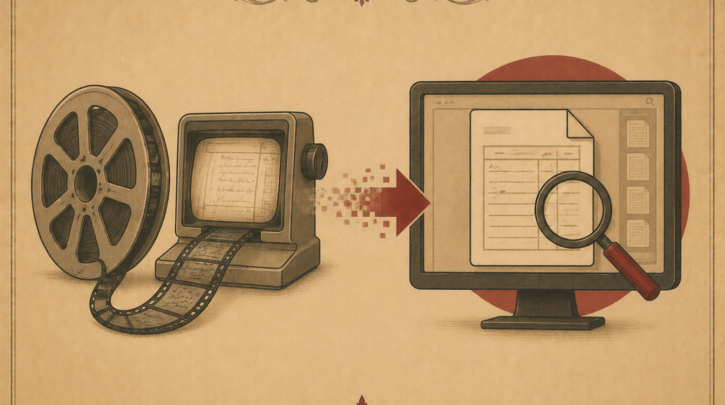

If there is one resource every researcher of Hungarian ancestry needs to know, it is FamilySearch, the vast free genealogy website run by a nonprofit. Decades ago it microfilmed an enormous share of Hungary’s church and civil records—including those of regions now beyond the borders—and much of that is now digitised and searchable online at no cost. Knowing how to use it well is central to Hungarian research.
Why FamilySearch is so important for Hungary
FamilySearch’s microfilming projects captured a huge portion of Hungary’s church registers and civil records, often before the access complications created by changing borders and archive policies. This means that for many villages—including those now in Romania, Slovakia, Serbia or Ukraine—the records may be viewable on FamilySearch even when reaching the originals in a foreign archive would be difficult. For the descendant of an emigrant, this is often the single most productive place to look.
Not sure where to start with your Hungarian ancestry?
Get the Hungarian Genealogy Quick-Start Checklist — a 6-step path to your first real ancestor record, plus how to work out which of six countries holds your family’s records today. No subscription required.
The catalog is the key
The most useful FamilySearch skill is using the catalog. Search the catalog by your village (a “Place” search), and it lists every record collection FamilySearch holds for that locality—church registers by denomination, civil registration, and more—with the years covered. This tells you at a glance what survives and is available for your specific place, which is invaluable for planning. Because the historic place may be cataloged under its old Hungarian name and county, knowing both the village and its historic and modern identity helps you find the right entry.
Some FamilySearch images carry access restrictions: a few can only be viewed at a Family History Center or affiliate library rather than from home, usually for contractual reasons. The records are still free; you may just need to view them at a participating location. Many Hungarian collections, however, are viewable online.
Searching and browsing
Where a collection is indexed, you can search by name—but Hungarian indexing is incomplete, and names are easily misread from old handwriting and across languages, so treat a name search as a helpful shortcut, not a guarantee. When a search comes up empty, fall back on browsing the register images for the right village, denomination and year, exactly as you would have done with the microfilm. Browsing the actual registers, page by page, is how much serious Hungarian research is still done, and it is often more reliable than trusting an index.
FamilySearch plus the free Hungaricana portal cover most of what you need, for free. See both on the records hub.
How it fits with the other resources
Think of FamilySearch as the workhorse of Hungarian genealogy, complemented by the others. Hungaricana adds Hungary’s own digitised civil registration and maps; the historic gazetteers help you place your village; and for records neither portal holds, a successor-state or diocesan archive may be the answer. But for most families, FamilySearch’s deep filmed collections—searchable, browsable, and free—are where the bulk of the discoveries happen, and where a Hungarian tree is built generation by generation back into the eighteenth century.
A practical FamilySearch workflow for Hungary
A reliable routine ties the site’s pieces together. Begin with a catalog “Place” search for your village—trying both its historic Hungarian name and, if needed, its modern name—to see exactly what FamilySearch holds for it and the years and denominations covered. Where a collection is indexed, run a name search to jump to candidate records; where it is not, open the digitised register and browse by year, denomination and event type. Log what you have searched so your effort accumulates rather than repeats, and cross-check against Hungaricana, which may hold civil records FamilySearch does not.
Treated this way, FamilySearch is less a single tool than a hub: the catalog to map what survives for your village, indexes to search, register images to read, and the center network for the few restricted items. For Hungarian research specifically, its great advantage is the breadth of its filmed church and civil registers across the whole historic Kingdom—including regions now beyond the borders—which means a remarkable amount can be accomplished from home before any need to approach a foreign archive.
Using the shared tree and hints with care
FamilySearch also hosts a single shared family tree and a hinting system. These can be useful leads—another researcher may have worked your line, or a hint may surface a record you missed—but because the tree is collaborative and anyone can edit it, treat any connection you did not document yourself as a hypothesis to verify in the original registers. Used critically, the shared tree can accelerate your research and connect you with others working the same village; taken on faith, it can import other people’s errors. As always in Hungarian genealogy, the register image is the evidence, and the index or tree is only the finding aid.