
The fear that stops many people from researching Hungarian ancestry is the records themselves: old handwriting, an unfamiliar language, and—surprisingly—not one language but three. It is a smaller obstacle than it looks. Hungarian records are highly formulaic, so you are not really translating prose; you are recognising a fixed set of words in a predictable structure. Learn a few dozen terms in each language and the layout of each record type, and you can read the great majority of what you will meet. Here is how.
Three languages, depending on era and church
The first thing to know is which language to expect. Hungarian records appear in three main languages:
- Latin — most older Catholic registers and many others before the mid-1800s; the formulas are fixed and very learnable.
- Hungarian — increasingly through the 1800s, in civil records after 1895, and commonly in Reformed registers.
- German — in Lutheran and ethnic-German communities, sometimes in old Gothic (Kurrent) handwriting.
Knowing the era and the denomination tells you which language to prepare for. Many families’ records shift language over time—Latin giving way to Hungarian, for instance—so it is worth being comfortable with the key words in more than one.
Not sure where to start with your Hungarian ancestry?
Get the Hungarian Genealogy Quick-Start Checklist — a 6-step path to your first real ancestor record, plus how to work out which of six countries holds your family’s records today. No subscription required.
Essential words in three languages
A small core vocabulary unlocks most records. The key event words across the three languages:
- Birth/baptism: született / keresztelés (Hungarian), natus / baptizatus (Latin), geboren / getauft (German).
- Marriage: házasság (Hungarian), matrimonium / copulati (Latin), Heirat / getraut (German).
- Death/burial: halál / temetés (Hungarian), mortuus / sepultus (Latin), gestorben / begraben (German).
- Relationships: fia/lánya (son/daughter), filius/filia (Latin), Sohn/Tochter (German); férj/feleség (husband/wife).
The forms are standardised
Good news: church and especially civil registers are highly formulaic, often pre-printed forms with the details written into the blanks. The surrounding text is identical from record to record—only the names, dates and places change. Once you have decoded one baptism record in a given language and denomination, you have effectively decoded them all, which makes the civil records and most church registers approachable even for beginners.
Practice on real records—they’re free. Open your village’s registers via FamilySearch and read along; everything is on the records hub.
Tackling the handwriting
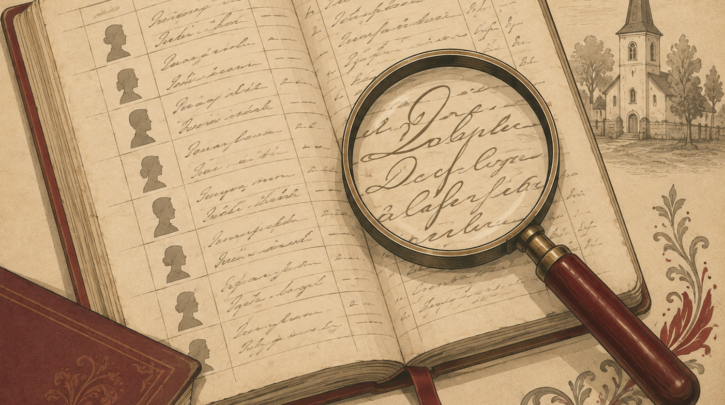
Old handwriting takes a little acclimatisation, but a few habits make it click: read in context, since the fixed format tells you what a word should be before you can read it; build a personal alphabet from letters you can read clearly; watch for abbreviations, which scribes used constantly; and compare the same name across several records to resolve ambiguous spellings. German records in old Kurrent script are the most challenging and may need a dedicated alphabet chart, but even these yield to practice. Combined with an awareness of Hungarian naming—the surname-first order, the Latin and German forms of given names—reading old Hungarian records is a skill that compounds quickly, and within an afternoon’s practice most people find they can read their family’s history in the original hand.
Working through your first record
The fastest way to learn is to decode one complete record slowly. Take a single baptism entry from your village on FamilySearch, identify the language and the fixed boilerplate (which never changes), and then isolate the handwritten details: the date, the child’s name, the parents’ names, the godparents. Look up any word you cannot place in a glossary of Hungarian, Latin or German genealogical terms. By the time you have fully understood one record, you will recognise the structure in every other entry of the same type and language, because they are all built on the same template.
Keep a personal cheat-sheet as you go—the event words in each language, the months, the numbers, and the way your particular scribe forms tricky letters. Within a few records this becomes second nature, and the work shifts from laborious decoding to quick scanning for the names and dates you need. The multi-language aspect sounds daunting but is manageable in practice, because at any given time you are usually working in just one language and one fixed format.
Dates, numbers and tools that help
A few specifics catch people out. Dates and ages are sometimes written out in words, so knowing the numbers in the relevant language matters, and Latin records may use Roman numerals or Latin month names. Lean on the tools that exist: printed and online glossaries of Hungarian, Latin and German genealogical terms, word lists tailored to church and civil records, handwriting guides for old German Kurrent script, and the active community of Hungarian-genealogy researchers happy to help decipher a stubborn entry. Combined with an awareness of Hungarian naming, which lets you predict names before you read them, these resources turn the intimidating into the routine faster than most beginners expect.