
There is one fact that unlocks Hungarian genealogy, and without it you are stuck: the village your family came from. Because Hungarian records are organised by locality and religion rather than by surname, “somewhere in Hungary” is not enough—you need the name of the place. The good news is that the clue is almost always in the records your ancestor left behind in their new country. This guide shows you where to look.
Why the village is everything
Hungary has no national, name-searchable index of births or marriages. The church and civil registers are organised by locality, so to find your ancestor you must browse the records of their particular village and, before 1895, their denomination. Identifying that village is therefore the prerequisite for everything else—and, in Hungarian research, it comes with a second step most countries do not require: working out which country the village is in today.
The best sources, roughly in order
Look first to the documents your immigrant ancestor generated after arriving. These are far more likely to name the exact village than anything on the Hungarian side:
- Naturalisation records — petitions and declarations often state the applicant’s exact birthplace; later naturalisations are especially detailed.
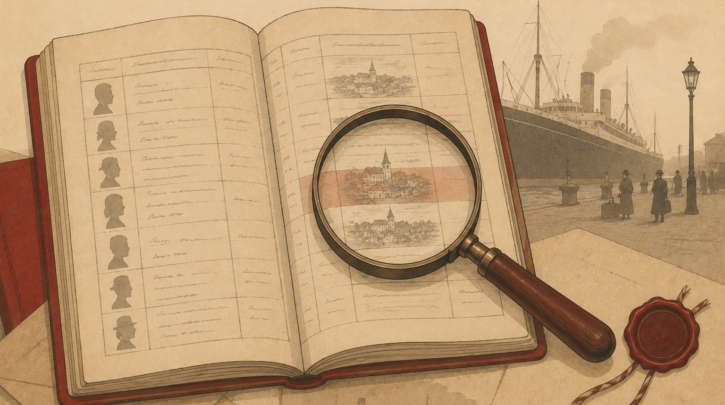
- Passenger manifests (ship records) — manifests from around 1900 onward frequently list the town of last residence, and even a relative left behind with their village; many are searchable online.
- Church records in the new country — the immigrant parish’s baptism and marriage registers sometimes record the Hungarian village of origin, and the family kept its religion, which is itself a clue.
- Vital and death records — marriage and death certificates abroad may name the birthplace and parents.
- Military and other records — draft cards and similar documents often ask for exact place of birth.
Not sure where to start with your Hungarian ancestry?
Get the Hungarian Genealogy Quick-Start Checklist — a 6-step path to your first real ancestor record, plus how to work out which of six countries holds your family’s records today. No subscription required.
Beware the spelling
Hungarian place names were frequently mangled by English-speaking clerks, written phonetically or confused with the county or the nearest city. A village name may appear in several wildly different spellings across documents. Sound the names out, compare them against a map and a gazetteer, and cross-reference several documents—a manifest, a naturalisation, a death record—to triangulate the true name. Remember too that the record might name a larger town or the county (megye/vármegye) rather than the small village your family actually lived in.
Found the village name? The next step is locating it across today’s borders—see which country is my village in now—then search the free records on the records hub.
Other clues when the documents are vague
If the paper trail only gets you to a region, a few more techniques help narrow it to a village. Chain migration means Hungarians from one village often settled together abroad, so identifying where your ancestor’s neighbours, witnesses and fellow parishioners came from can reveal the shared home village. Religion and ethnicity narrow the field, since some areas were predominantly Catholic, Reformed, German or Slovak. And DNA matches who know their village, or whose trees point to one, can break the wall—see DNA testing. Finding the village takes patience, but it is the highest-value work in all of Hungarian genealogy, because everything else depends on it.
Reading immigrant documents closely
The documents your ancestor created after emigrating reward careful, patient reading, because the village name is often there—just disguised. A passenger manifest from the early twentieth century may record not only the town of last residence but the name and village of the nearest relative left behind, frequently a parent in the home village. A naturalisation petition may state the exact birthplace. A death certificate may name the parents and birthplace. Each document is a potential key, and two together often confirm a village that neither states unambiguously on its own.
The challenge is almost always the spelling. An English-speaking clerk, hearing an unfamiliar Hungarian place name, wrote it as best he could, so the same village may appear in several barely recognisable forms. Sounding the name out, comparing it against a gazetteer of the historic Kingdom, and checking it against the county or region your other evidence suggests will usually resolve it. Patience here pays off enormously, because the village is the key to everything that follows.
Confirming the village once you have a candidate
When you have a likely village, confirm it before investing hours in its records. Identify its modern country and name, locate its church registers for the right denomination on FamilySearch, and look for your surname in the years you expect—finding the family’s baptisms and marriages there, with parents’ names matching what you already know, is the confirmation that you have the right place and not a same-named village elsewhere. This quick check, made before deep research, saves enormous wasted effort and marks the true beginning of your work in the Hungarian records.