
In Hungarian genealogy, the village is everything—the place that recorded your family’s births, marriages and deaths, the community they lived their lives within, and, very often, somewhere that still stands much as they knew it. Visiting it is the most personal thing a heritage traveller can do. This guide explains how to make that visit meaningful: what to arrange in advance, what to see, and how to handle the particular Hungarian reality that your village may lie across a modern border.
Prepare before you arrive
A rewarding visit starts months earlier, with research. Identify your village for certain and establish which country it is in today, trace your family there in the free records, and note the specific people, dates and places you want to connect with on the ground—the church of a baptism, the cemetery, a family home if you can locate it. Arriving with this knowledge transforms the visit: you are not wandering a pretty village but walking through your own documented history.
Wherever possible, make contact ahead of time. A polite message—ideally in Hungarian, and in the local language if the village is in a successor state—to the parish or to local contacts, explaining that you descend from a family of the village and hope to visit, can arrange access to records, point you to the family’s part of the cemetery, and occasionally connect you with relatives still living there. The Hungarian communities of Transylvania, Slovakia and the Vojvodina often respond warmly to a returning descendant.
Not sure where to start with your Hungarian ancestry?
Get the Hungarian Genealogy Quick-Start Checklist — a 6-step path to your first real ancestor record, plus how to work out which of six countries holds your family’s records today. No subscription required.
The church and the cemetery
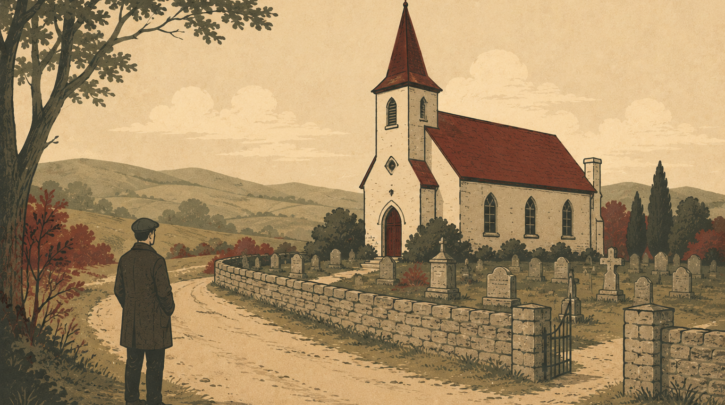
For many travellers the church and the cemetery are the most moving places of all. The church is very likely where your ancestors were baptised and married, its registers—if still held locally—the very books their lives were recorded in. The cemetery holds the family names on its stones, generation beside generation; even where the oldest graves are gone, a family plot connects you physically to people you have known only on paper. Bring your traced line, a notebook and a camera, and take a moment when you find them.
Find the village, its country, and your family in it before you go—everything follows from that. The records hub has the free tools, and the heritage trip guide shows how to weave the visit into a full itinerary.
Meeting relatives across the border
An ancestral village often still holds family, and in the successor states this is especially likely, because Hungarian communities there have endured for a century since the borders moved. If a DNA test or earlier correspondence has connected you with cousins, meeting them in person is an experience no museum can match—they can show you the family’s places, share photographs and stories, and welcome you as one of their own. Even without prior contact, a surname inquiry in the village—at the church, in the square—sometimes reveals living relatives, since in a small place your name may still be local. Approach such encounters with warmth, patience, and a little Hungarian.
Seeing the records in person
A heritage visit is also a research opportunity. Records not yet digitised may sit in the local parish, a diocesan archive, or a regional state archive—which, for a village in a successor state, will be that country’s archive. Seeing the original register your ancestor’s baptism was written in is unforgettable. Our guide to researching in the archives in person covers how to do this respectfully and productively—remembering that these are working offices and sacred spaces, not tourist attractions, and that a successor-state archive may operate in its own language and rules.
Walk the landscape they knew
Finally, give yourself time simply to be in the place. Walk the lanes and the surrounding countryside, see the church tower your ancestors walked toward on Sundays, look out at the same fields, hills or river they did. Eat in the village, hear the local Hungarian, sit where the community gathers. Standing in the landscape that shaped your family—the very ground they farmed—is what finally turns a name in a register into an ancestor. For most heritage travellers, it is the moment the whole journey through the records was quietly leading toward, and the beginning of reclaiming what the family had lost.
Reading the village itself
Beyond the specific sites, an ancestral village rewards a slower, attentive look, because the place itself is a document. The layout of the lanes, the central square, the church at its heart, the surrounding fields—all of it is the physical world your ancestors moved through every day. Older villages often retain the shape and many of the buildings your family would have known, and walking them with that awareness turns sightseeing into a kind of communion. Look for the things that endured: the church, the war memorial that may carry your surname, the oldest houses, the well or the mill.
Small villages also hold local knowledge that no archive captures. The parish priest or pastor, an elderly resident, the keeper of the cemetery—people who may remember families, point you to a relative, or share a story about the name you carry. A respectful, curious presence, helped by a little Hungarian (and the local language in a successor state), often opens these doors. The welcome a returning descendant receives in a small Hungarian village can be genuinely moving, precisely because you have come, with evident care, in search of your own.
Photographs and respect
Photograph generously but thoughtfully: the church and its interior, the cemetery and the family stones, the lanes, the landscape, the village sign with its name (often in two languages, where the village lies across a border). These images become part of your family record and gifts for relatives who cannot make the journey. Remember that working churches, cemeteries and offices are not tourist attractions but sacred and civic spaces—visit quietly, follow any guidance, and if a service is underway, simply wait or join it. The care you show honours both the place and the ancestors who made it yours, and it is part of beginning to reclaim the heritage you came to find.