
The great migration of the early twentieth century was not the only wave of Hungarian emigration. The most dramatic later chapter came in 1956, when, after the Hungarian Revolution was crushed by Soviet forces, some 200,000 Hungarians fled their country. These refugees—the “fifty-sixers”—form a distinct and important part of the Hungarian diaspora, and if your family left Hungary in or just after 1956, their story and their records differ from those of the earlier emigrants.
The revolution and the exodus
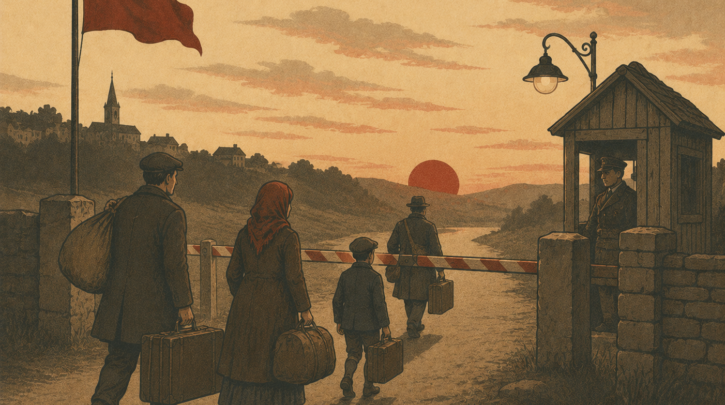
In October 1956, a popular uprising against Soviet domination briefly succeeded before being crushed by a Soviet military intervention in November. In the weeks and months that followed, as borders briefly opened and fear of reprisals spread, around 200,000 people—roughly two percent of Hungary’s population—fled, most crossing into Austria (and some into Yugoslavia) before moving on. It was one of the largest and fastest refugee movements of the Cold War, and it drew a sympathetic international response.
Not sure where to start with your Hungarian ancestry?
Get the Hungarian Genealogy Quick-Start Checklist — a 6-step path to your first real ancestor record, plus how to work out which of six countries holds your family’s records today. No subscription required.
Where they went
The fifty-sixers were resettled across the Western world. Major destinations included:
- The United States — which admitted tens of thousands under special refugee measures.
- Canada — a particularly significant destination, taking in a large number of refugees.
- The United Kingdom, Germany, Switzerland, France and other Western European countries.
- Australia and others further afield.
Unlike the economic emigrants of the great migration, the fifty-sixers were political refugees, and they included a notably high proportion of students, professionals and skilled workers.
Researching a 1956 refugee ancestor
Because they left recently and under refugee programmes, the fifty-sixers generated a different set of records from the earlier emigrants. Useful sources include:
- Refugee and resettlement records — the documentation created by the agencies and governments that processed and resettled refugees, often via Austrian camps.
- Immigration and naturalisation records in the destination country.
- Hungarian records before departure — civil registration and other records up to 1956, subject to the usual privacy restrictions on recent records.
Records of people who are living or recently deceased are subject to privacy restrictions in Hungary and elsewhere, so research into a 1956 refugee’s recent history may rely more on family knowledge and destination-country records than on open Hungarian archives. Living relatives are often the best source for this generation’s story.
Whatever wave your family left in, the path back into Hungary runs through the same records. Trace it with the research guide and the free Hungarian records.
Connecting to the deeper roots
A fifty-sixer ancestor is, for the genealogist, a relatively recent emigrant, which means the bridge back into Hungary is short—and because they left from within Hungary’s post-Trianon borders, you usually do not face the successor-state complication that the great-migration generation does. Once you have established the family’s situation up to 1956 from destination-country and family sources, the Hungarian civil records and church registers take you back from there into the nineteenth century and beyond, exactly as for any Hungarian line. The 1956 chapter is a dramatic and recent one, but it sits atop the same deep Hungarian record-keeping that this site helps you explore.
A different kind of emigrant
The fifty-sixers differed from the great-migration emigrants in ways that shape both their story and their records. They were political refugees fleeing a failed revolution, not economic migrants seeking work, and they left suddenly, in a concentrated few months, under the eyes of a sympathetic international community that mounted an organised resettlement effort. Their ranks included a high proportion of students, intellectuals and skilled professionals, and they generally left intending not to return—a sharp contrast to the “birds of passage” of the earlier era. Understanding this difference helps you know what records to expect and how to interpret a fifty-sixer ancestor’s path.
Their reception abroad was shaped by the Cold War politics of the moment. Western governments, eager to aid those fleeing Soviet repression, created special programmes to admit and settle them quickly, which generated distinctive refugee, camp and resettlement records—often beginning in the Austrian camps where most refugees first arrived. These records, alongside ordinary immigration and naturalisation files in the destination country, document a journey that was political and humanitarian as much as personal.
Talking to the living generation
Because 1956 is within living memory, the most valuable source for a fifty-sixer ancestor is often not an archive but a person. Refugees of that era, and their children, may still be able to recount the revolution, the escape across the border, the camps, and the resettlement in vivid first-hand detail—the kind of testimony that no document captures and that privacy restrictions on recent official records make all the more precious. Recording these memories, ideally with names, dates and the home places in Hungary, is itself an act of preservation, and it gives you the anchor you need to connect the recent refugee chapter to the deeper Hungarian records behind it. For this generation especially, the family interview is genealogy of the highest value.