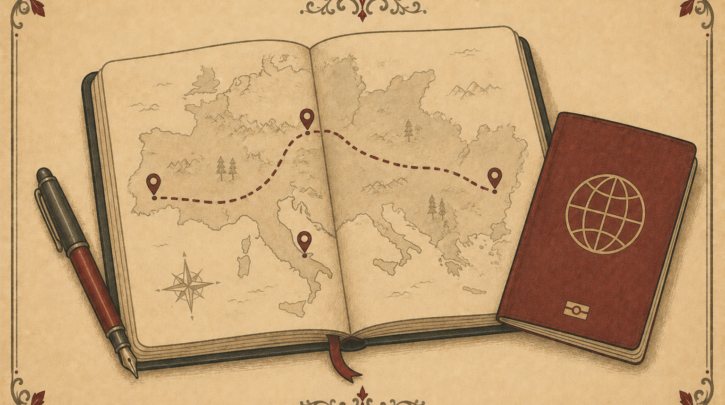

There is a moment in many family-history journeys when the names on the screen are no longer enough—when you want to stand in the village square your great-grandparents knew, see the church where they were baptised, walk the lanes they left. A Hungarian heritage trip turns generations of records into something you can touch. This guide will help you plan one that is genuinely yours: not a generic tour of Budapest, but a journey to your family’s village—wherever in Central Europe it lies today.
That last point is the heart of Hungarian heritage travel and what sets it apart. Because the borders moved in 1920, your ancestral village may not be in Hungary at all, but in Romania, Slovakia, Serbia, Ukraine, Austria or Croatia. Planning a Hungarian roots trip therefore begins with knowing not just the village, but the country it sits in now.
Step one: do the genealogy first
Before you book anything, identify the exact place your family came from. A heritage trip built on “somewhere in Hungary” is just a holiday; a trip built on “the village of X in historic Y county, now in Romania, where my great-grandparents married in 1894” is a pilgrimage. Because Hungarian everything—records, identity, the trip itself—is organised around the village, finding your ancestral village, and then which country it is in now, is the essential first task.
The whole trip begins with the village and its modern country. Identify both using the free records—see the records hub—and consider testing beforehand so you can meet living cousins on the journey.
Not sure where to start with your Hungarian ancestry?
Get the Hungarian Genealogy Quick-Start Checklist — a 6-step path to your first real ancestor record, plus how to work out which of six countries holds your family’s records today. No subscription required.
Step two: research the place before you go
Once you know the village and its country, learn everything you can before you travel. Find it on a map, read its history, identify the church and the cemetery, and—if possible—make contact in advance with the parish or local people. Doing the records research first, on the free FamilySearch and Hungaricana, means you arrive knowing exactly which ancestors were born, married and buried there, and when—so that standing in the church or the square, you are meeting documented people, not abstractions. Our guide to visiting your ancestral village covers this in detail.
Step three: connect with relatives
One of the most rewarding parts of a Hungarian heritage trip is meeting family who never emigrated. Many ancestral villages still hold relatives—particularly in the Hungarian communities of the successor states, where Hungarian families have lived for generations—and a DNA test taken before the trip can connect you with cousins who can welcome you, show you the family’s places, and share stories and photographs no archive holds. Reaching out ahead of time, ideally in Hungarian, can transform a visit from sightseeing into a genuine homecoming.
Step four: experience the wider heritage
Your ancestral village sits within a region with its own deep character, and experiencing that wider regional and successor-state heritage brings your family’s world to life. A trip to Hungarian Transylvania feels different from one to southern Slovakia or to the Hungarian Great Plain, because each holds the Hungarian culture in its own setting and history. Build time to eat the regional food your ancestors ate, hear the local Hungarian dialect, and understand the place and the history—especially the story of Trianon—that shaped them.
Practical planning
A few practicalities make a Hungarian heritage trip smoother. Small villages, especially across borders, are usually reached by car, so plan to drive and base yourself nearby. Contact the parish ahead of time if you hope to see church records or the building itself. Crossing into a successor state may mean dealing with a different language (Romanian, Slovak, Serbian) even where Hungarian is widely spoken locally—a little of both goes a long way. And consider timing your visit to a village búcsú (the patron-saint festival and fair) or a folk festival, when the living culture is on full display.
Make it personal
The best heritage trips are not the ones that see the most sights; they are the ones that connect you to your own people. Visit the church where your ancestors were baptised and the cemetery where the family names are carved in stone. Walk the lanes they walked. If you have made contact, share a meal with cousins. Carry a copy of your traced line so that, standing in the village, you know exactly who lived there and when. This, in the end, is what the whole journey through the records was leading to—and it often becomes the first step in fully reclaiming a heritage that emigration, or the redrawing of a border, had set aside.
Ready to build your trip around your own family? Start with finding your village and its modern country, ground every stop in the records, and see how to research on the ground in visiting your ancestral village.
When to go, and for how long
Timing shapes the trip. Late spring and early autumn offer warm weather, smaller crowds and comfortable temperatures, ideal for the rural villages most heritage travellers visit; high summer can be hot, and deep winter makes rural travel harder. If you hope to visit a parish or archive, avoid major holidays and confirm hours in advance. Many villages hold a búcsú—the patron-saint festival and fair—on a particular day, and folk festivals dot the calendar; timing your visit to coincide is a wonderful way to see the living culture, though it means busier roads and accommodation.
Give the trip enough room to breathe. Beyond the village itself—which may occupy a day or two of visiting the church, cemetery and, if you are lucky, relatives—allow time to experience the surrounding region, which is where your family’s wider world comes alive. A week lets you combine the village with its region without rushing the emotional heart of the journey; longer lets you reach more distant lines, cross a border to a second ancestral area, or pair the roots trip with Budapest and the rest of Hungary.
Travelling prepared
Pack a working genealogy kit: a clear chart of the line you are following, copies of key records, the village and parish details, the historic county and modern country, and any contacts you have made in advance. A tablet or laptop with offline access to your tree and the register images is invaluable when you are standing in a church or archive and want to check a date on the spot. The travellers who get the most from a roots trip are almost always the ones who did the research before they left—arriving with questions to answer rather than hoping to start from scratch—and who, crucially, sorted out which country the village is in before booking anything.