
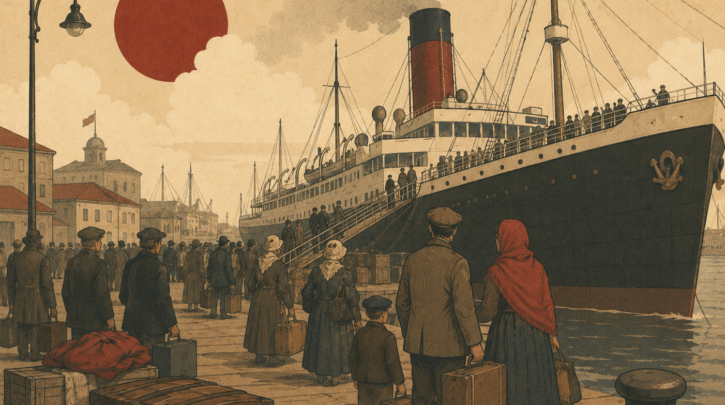

Before the new world there was the long journey to the sea. For the Hungarians who left during the great migration, the voyage began with a railway journey across Central Europe to a port, and then a steamship across the Atlantic. Hungary even had its own seaport. Knowing which ports your ancestors likely used adds texture to their story and context to the records of their departure.
Fiume: Hungary’s own port
The Kingdom of Hungary had a single seaport: Fiume, on the Adriatic, today the city of Rijeka in Croatia. From the 1900s a direct steamship line—operated under arrangement with the Cunard Line—ran from Fiume to New York, deliberately giving Hungarian emigrants a route that kept them and their fares within the Kingdom rather than flowing through the German ports. For many emigrants, especially in the years just before the First World War, Fiume was the point of departure, and a departure from Fiume is a strong sign of a journey organised through the Hungarian system.
Not sure where to start with your Hungarian ancestry?
Get the Hungarian Genealogy Quick-Start Checklist — a 6-step path to your first real ancestor record, plus how to work out which of six countries holds your family’s records today. No subscription required.
Hamburg and Bremen: the German gateways
Despite Fiume, enormous numbers of emigrants from the Kingdom of Hungary left through the great German ports of Hamburg and Bremen (its emigration port at Bremerhaven). These were the dominant gateways for Central and Eastern European emigration, with established networks of agents and railways feeding them. The Hamburg passenger lists in particular are a famous and valuable genealogical source, recording emigrants’ details—including place of origin—as they departed, and they survive and are searchable for much of the great-migration era.
Trieste and other routes
Trieste, the main port of the Austrian half of the monarchy, also carried emigrants, particularly toward the end of the period and for certain destinations. Other travellers reached ports such as Antwerp, Le Havre or Rotterdam by rail. The route an emigrant took depended on cost, the agent who sold them their ticket, their destination and the year—and while it is mostly a matter of context rather than a research key, the departure port can be a useful confirmation of the path your family took.
The port was the start of a journey that often ends, for researchers, at the home village. Trace it back with the research guide and the free Hungarian records.
What the journey was like
For most emigrants, the voyage was an ordeal endured in hope. They travelled in steerage—the cheapest, most crowded class deep in the ship—for an Atlantic crossing of one to two weeks, after a rail journey of hundreds of miles to reach the port. Conditions were cramped, food and sanitation poor, seasickness common. Before boarding, emigrants faced medical inspections; before landing at Ellis Island, more awaited them. That so many made this journey—often more than once, as “birds of passage”—speaks to how hard life at home had become and how strong the pull of opportunity was.
Departure records and your research
Knowing the likely port matters mostly for context, but it can also point you to useful records. The Hamburg passenger lists are the standout: where they cover your ancestor, they record the departure as the arrival manifest records the landing, and the two together build a fuller picture of the journey—sometimes the departure record names the home place more clearly than the arrival one. Mostly, though, the port reflects the route and the era, and helps you picture the human reality behind the manifest line: a family on a distant Adriatic or North Sea dock, having travelled across a continent, about to cross an ocean toward a name they had only heard in letters.
Why the port reflects the route
The port an emigrant used was rarely a free choice; it reflected a whole system of agents, railways, prices and politics. The Hungarian state actively promoted departure through Fiume to keep emigrants—and their substantial fares—within the Kingdom, arranging the Cunard service to New York for exactly that reason. The German ports, by contrast, were fed by a vast, well-organised network of agents reaching deep into Central Europe. Which port your ancestor used therefore hints at when they left, who sold them their ticket, and which route the migration system steered them along.
For research, this means the port is mainly context, but useful context. A departure from Fiume points to the later great-migration years and the Hungarian-organised route; a departure through Hamburg or Bremen points to the broad Central European emigration network and brings the valuable German departure records into play. Either way, knowing the likely port helps you picture the journey accurately and tells you which departure-side records might supplement the arrival manifest.
The emigration business
Behind the great migration lay a large commercial enterprise. Steamship companies competed fiercely for the emigrant trade, employing networks of local agents who sold tickets in the villages, arranged the rail journey to the port, and shaped the flow of people toward particular ports and lines. Prepaid tickets sent home by relatives already in America financed many crossings, reinforcing the chain migration that brought whole villages to the same American neighbourhoods. Understanding this business demystifies the journey: your ancestor was moving through an organised, profit-driven system that funnelled millions of Central Europeans across the Atlantic, and the records that system generated—tickets, agent ledgers, passenger lists—are part of what survives to document their passage.