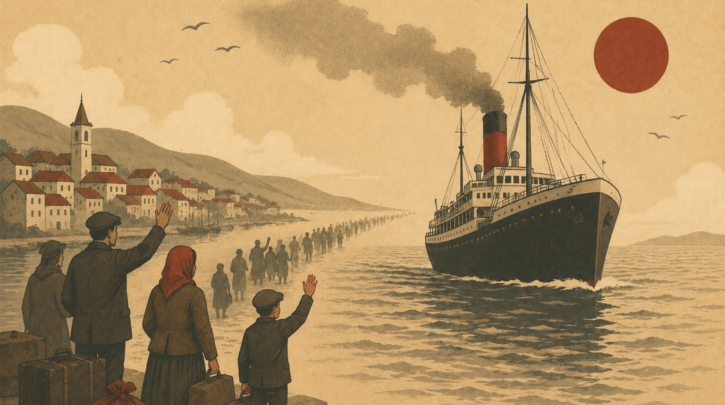

Between roughly 1880 and 1914, the Kingdom of Hungary sent an extraordinary number of its people across the ocean—by most estimates well over a million and a half to the United States alone, with many more to other destinations. If you are researching Hungarian ancestry, your family was very likely part of this great migration, and understanding it is the key to understanding why, when and how they left. This guide tells that story—and the later waves, including the refugees of 1956—and shows where the records lead.
One thing to understand from the outset: the emigrants from the Kingdom of Hungary were not all ethnic Magyars. The Kingdom was multi-ethnic, and those who left included Slovaks, Germans, Croats, Rusyns, Romanians, Serbs and a large number of Jews, alongside Hungarians. All of them left from the historic Kingdom, all generated the same kinds of records, and all are part of the story this site helps you trace back to a specific village.
Why they left
The causes were many and overlapping, but most came down to economic hardship in a rapidly changing society:
- Rural poverty and land hunger — a growing population on limited land, with many families landless or holding too little to live on.
- The pull of American wages — word of work in the mines, mills and factories of the United States, carried home in letters and remittances.
- Agricultural change and debt — economic pressures that pushed peasant families toward emigration as a way to survive or get ahead.
- Avoiding military service and seeking opportunity — among the motives for many young men in particular.
For most, emigration was an economic strategy rather than a rejection of home—and, as we will see, very many intended to return.
Where they went
The overwhelming destination was the United States, and within it the industrial heartland: Cleveland (which became one of the largest Hungarian cities in the world), Pittsburgh and the steel towns of Pennsylvania, New York, Chicago, Detroit, and mining and mill towns across the Northeast and Midwest. Others went to Canada, and later waves reached Western Europe, Australia and beyond. Where your family landed shaped the records of their arrival and their new life—explored in our guide to the communities Hungarians built.
Your emigrant ancestor’s journey is documented—and those records often name the home village. Learn to use them in finding your Hungarian immigrant ancestor, and find the records on the records hub.
Not sure where to start with your Hungarian ancestry?
Get the Hungarian Genealogy Quick-Start Checklist — a 6-step path to your first real ancestor record, plus how to work out which of six countries holds your family’s records today. No subscription required.
The journey
Most emigrants travelled overland by rail to a port and then by steamship across the Atlantic. The Kingdom of Hungary had its own seaport at Fiume (today Rijeka, in Croatia), from which a direct line ran to New York, while many others left through the great German ports of Hamburg and Bremen, or through Trieste. For most, arrival in the United States meant Ellis Island. Our guides to the ports of emigration and Ellis Island follow the voyage in detail.
The ‘birds of passage’
A striking feature of the Hungarian great migration is how many emigrants returned home. Large numbers—especially young men—were “birds of passage” who came to earn money and intended to go back to buy land or improve the family’s position. Many did return; some crossed more than once. This pattern explains why some ancestors seem to vanish from American records—they may have gone home—and it is part of why Hungarian emigration records exist on both sides of the ocean.
Later waves: 1956 and beyond
The great migration ended with the First World War and immigration restrictions, but Hungarian emigration did not. The most famous later wave came after the 1956 Revolution, when around 200,000 Hungarians fled the Soviet crackdown—the “fifty-sixers,” who reached the United States, Canada, Western Europe and Australia. Earlier, the interwar years and the aftermath of the Second World War sent others abroad as well. Our guide to the 1956 refugees covers that distinctive chapter, and the Trianon diaspora explains the millions of Hungarians who found themselves abroad without ever leaving their villages.
Why the migration matters to your research
Understanding the great migration is practical genealogy. It tells you which ports and years to search, why your family settled where they did, who their neighbours and fellow parishioners were likely to be, and how to read the chain that connects a Cleveland street back to a specific village in the old Kingdom. Above all, it reminds you that the immigrant generation is the bridge: their arrival and naturalisation records, more than anything on the Hungarian side, often hold the name of the village that unlocks everything before them.
Trace your family across the ocean: start with finding your immigrant ancestor and the Ellis Island records. Ready to go further back? The research guide takes you into the Hungarian records.
A migration of many peoples
It bears repeating, because it surprises so many researchers, that the great migration from the Kingdom of Hungary was not a migration of Magyars alone. The Kingdom was one of Europe’s most ethnically diverse states, and those who sailed from its territory included large numbers of Slovaks from the north, Germans (Saxons and Swabians) from various regions, Rusyns from the Carpathian northeast, Croats and Serbs from the south, Romanians from Transylvania, and a very substantial number of Jews. To an American clerk they might all be recorded as “Hungarian” by country of origin, even when their mother tongue and identity were something else.
This matters for your research in concrete ways. Your “Hungarian” ancestor’s mother tongue, religion and surname may point to one of these communities, which in turn tells you which church registers to search and helps explain the family’s later path in America. Far from complicating the story, embracing this diversity usually clarifies it—and it connects your family to the rich, multi-ethnic world of the historic Kingdom that this site helps you explore.
The scale and its legacy
The numbers are staggering: in the peak years before the First World War, emigration from the Kingdom of Hungary ran into the hundreds of thousands in single years, and the cumulative total across the great-migration era reached into the millions. Whole regions saw a significant share of their young people depart, remittances from America reshaped village economies, and the communities the emigrants built abroad—in Cleveland, Pittsburgh and beyond—became lasting centres of Hungarian life outside Hungary.
For descendants today, that scale is precisely why the records are so rich and so findable. A migration this large was documented at every stage—departure, voyage, arrival, naturalisation, community life—and those documents, read together, routinely lead back across the ocean to a single village. The great migration scattered Hungarian families across the world, but it also left, in its paper trail, the means to find the way home again.