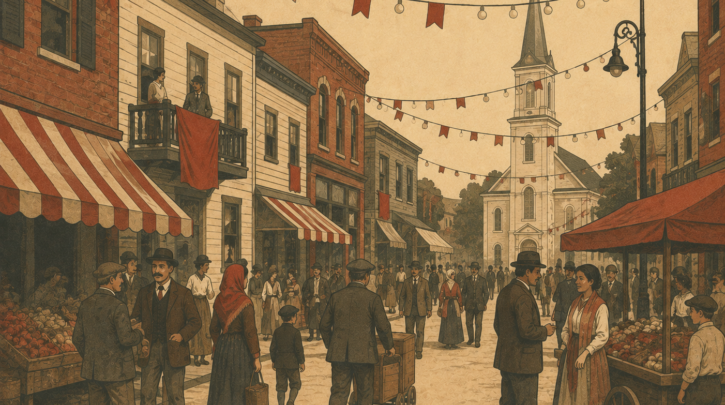

When Hungarian immigrants arrived in America during the great migration, they did not scatter and vanish into the crowd. They gathered—in dense, vibrant neighbourhoods, around their churches and societies, recreating as best they could the world they had left. Understanding these communities illuminates how your ancestors lived, and—crucially for the genealogist—the records they left behind, which often name the home village in Europe.
The great Hungarian neighbourhoods
Hungarian immigrants clustered in the industrial cities, and some neighbourhoods became famous centres of Hungarian-American life. Cleveland, Ohio—its Buckeye Road district in particular—became one of the largest concentrations of Hungarians anywhere outside Hungary, sometimes called the “American Debrecen.” Pittsburgh and the Pennsylvania steel and coal towns, New York, Chicago, Detroit, South Bend and Bridgeport all held substantial communities. Because Hungarians from one region or village often followed one another to the same place, these neighbourhoods clustered by origin—a real research clue, since your ancestor’s neighbours were frequently their villagers.
Not sure where to start with your Hungarian ancestry?
Get the Hungarian Genealogy Quick-Start Checklist — a 6-step path to your first real ancestor record, plus how to work out which of six countries holds your family’s records today. No subscription required.
The churches
Faith was central, and Hungarian immigrants built national churches reflecting the same denominational diversity as back home: Roman Catholic and Greek Catholic parishes, and a particularly strong network of Hungarian Reformed (Calvinist) churches, as well as Lutheran congregations and Jewish communities. These churches were the spiritual and social heart of the community, and their baptism, marriage and burial registers are valuable records—they preserve the family’s religion (essential for finding the right registers in Hungary) and sometimes record the European village of origin.
Fraternal societies and newspapers
Hungarian immigrants built a dense web of institutions that structured daily life and left records behind:
- Fraternal and mutual-aid societies — organisations that provided insurance, sick benefits and burial funds, and fostered community; their records and the cemeteries they maintained can reveal origins and relationships.
- Hungarian-language newspapers — which carried news, advertisements and notices of births, marriages and deaths.
- Businesses, halls and clubs — the groceries, taverns, churches’ halls and cultural societies that served the community and appear in city directories.
Community records—church registers, society rolls—can preserve the religion and name the home village. When they do, the free Hungarian records and the research guide take you the rest of the way back.
Why the community matters for research
For the genealogist, the great practical value of these communities is the paper trail they generated and the origins they preserve. The national church is often the richest source, its registers documenting the community’s families and frequently recording the Hungarian village; the fraternal societies’ records can point to origins; and the census, read street by street through a Hungarian neighbourhood, reveals the clustering of families from one region or village. Researching the community, not just the individual, is a genuine technique for breaking the village-of-origin brick wall—and it frames the human story between emigration and assimilation, the world your ancestors actually inhabited in their new country.
Using community records as a research strategy
Treating the community as a research subject in its own right is one of the most effective ways to break a village-of-origin wall. Because Hungarians from one place clustered together abroad, the people around your ancestor in the records—fellow parishioners, witnesses at their wedding, godparents to their children, neighbours on the census, members of the same society—were disproportionately from the same home village or region. When your ancestor’s own records will not name the village, the records of the people around them frequently will, and that shared origin is usually your family’s too.
The national church is the richest single source in this strategy. Its registers gather the community’s families in one place, preserve their religion, and sometimes record European origins directly; its anniversary books and histories may list founding families and their home villages. Combined with the census read street by street and the records of the fraternal societies, the church register turns the immigrant community from background into evidence—a map of connections leading back to specific places in the old Kingdom.
The decline and memory of the neighbourhoods
The great Hungarian neighbourhoods did not last forever. As generations assimilated, prospered and moved to the suburbs, the dense old districts thinned, churches merged or closed, and the Hungarian shops and halls gave way. Yet the records they generated endure, and so does the memory—in surviving congregations, historical societies, festivals and family story. For the genealogist, these institutions and their archives, even in decline, remain valuable: a parish that still holds its old registers, a fraternal society’s preserved records, or a local historical collection can hold exactly the document that names a home village. The neighbourhood that shaped your ancestors’ American lives is also, in its paper remains, a key to their European origins.