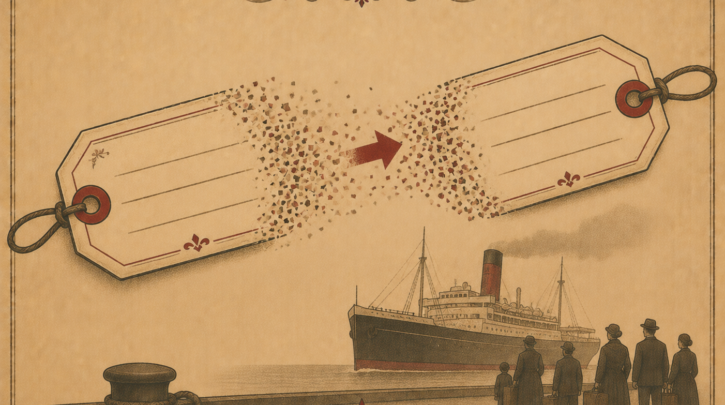

If your family emigrated, the surname you carry today is probably not exactly the one your ancestors brought from Hungary. As Hungarian immigrants and their children settled into life abroad, names shifted—respelled, reordered, sometimes translated—in the long process of assimilation. For the genealogist this is a crucial obstacle, because the Hungarian records hold the original name in its original order. Recovering it is often the difference between finding your family and losing the trail at the water’s edge.
First, dispel the Ellis Island myth
The popular story that names were changed by officials at Ellis Island is a myth. Immigration officials worked from passenger manifests written at the European port of departure and did not assign new names. Name changes happened later and voluntarily, as immigrants and especially their children adapted their names to their new country. This matters for research: the name on the arrival manifest is almost always the true Hungarian original, which makes the manifest doubly valuable.
Not sure where to start with your Hungarian ancestry?
Get the Hungarian Genealogy Quick-Start Checklist — a 6-step path to your first real ancestor record, plus how to work out which of six countries holds your family’s records today. No subscription required.
The surname-first flip
The first change unique to Hungarian names is the order. In Hungary the surname comes first—Nagy János—but on emigration the order was flipped to Western style, becoming János Nagy and then John Nagy. Usually this is straightforward, but occasionally a clerk abroad mistook which name was which, recording the given name as the surname. When matching diaspora records to Hungarian ones, always be alert to the order, and to the possibility that a “surname” abroad was actually your ancestor’s given name.
How Hungarian names changed
Beyond the flip, anglicisation took several forms, and recognising them helps you reverse them:
- Respelling for pronunciation — Hungarian spellings and accents recast for English: Kovács to Kovach or Kovacs, Szabó to Sabo, Székely to Sekely, the accents dropped.
- Phonetic Americanisation — the name rewritten as it sounded to an English ear, sometimes far from the original (Nagy, pronounced roughly “nodge,” sometimes respelled accordingly).
- Translation — a meaning-based change: Kovács (“smith”) to Smith, Szabó (“tailor”) to Taylor, Molnár (“miller”) to Miller.
- Simplification — a long or difficult name shortened or smoothed.
The original name lives in the arrival manifest and the Hungarian records. Recover it, then search the free Hungarian records with the real spelling and order.
How to recover the original name
Finding the true Hungarian form is detective work, and the immigrant-era records are your best evidence:
- Work back to the immigrant generation — the earliest records (arrival, early naturalisation, the immigrant’s own marriage) carry the name closest to its original form and order.
- Read the passenger manifest — written at the European port, it usually preserves the authentic Hungarian spelling, surname first.
- Compare multiple records — seeing the name written several ways reveals the drift and points back to the source.
- Sound it out — reverse the phonetic change by asking what Hungarian spelling would produce the anglicised version.
- Consider translation — if the family name is an English occupational word (Smith, Taylor, Miller), check whether it translates a Hungarian original (Kovács, Szabó, Molnár).
Given names changed too
It was not only surnames. Given names were anglicised wholesale—István to Steve, György to George, József to Joseph, Erzsébet to Elizabeth, Ferenc to Frank. An ancestor known all their American life as “Frank” may sit in the Hungarian baptism register as Ferenc. Knowing the standard Hungarian-to-English given-name conversions—and pairing them with the naming conventions—keeps you from losing a person at the moment their record crosses the ocean. With the original surname, the original order and the original given name recovered, the family that seemed to vanish on arrival reappears in the Hungarian registers.
A worked example of reversing the change
Imagine a family known in America as “Smith,” with a firm tradition of Hungarian origin, but no “Smith” to be found in the Hungarian records. Reading their earliest American documents—the immigrant’s arrival manifest and first marriage—you find the name written Kovács. The family had translated the meaning, “smith,” into English. In the Hungarian registers they appear as Kovács, a connection invisible until you knew to look for the translation. This is exactly how anglicisation hides a family, and exactly how careful reading of the earliest records recovers them.
The same logic applies across the kinds of change. A name simplified or respelled for English is reversed by sounding it out; a translated name is recovered by knowing the meaning (Smith–Kovács, Taylor–Szabó, Miller–Molnár); the surname-first flip is undone by checking the order in the immigrant-era records. In every case the principle is the same: the closer a record is to the moment of emigration, the closer the name is to its Hungarian truth, so you work backward toward the manifest and the Hungarian registers rather than forward from today’s anglicised form.
Don’t forget the women, and the religion
Two further points round out the picture. First, Hungarian women appear under their maiden names in the Hungarian records, which is enormously helpful—but abroad they were usually recorded under their husband’s name, and their own maiden name may itself have been anglicised, so recovering a female ancestor’s original Hungarian maiden name is often the key to extending the maternal lines. Second, recovering the name goes hand in hand with recovering the religion: because Hungarian records are kept by denomination, knowing both the original name and the family’s faith is what lets you walk into the right registers. Treat the name and the religion together as the twin keys that turn the family’s American chapter back into its Hungarian one.