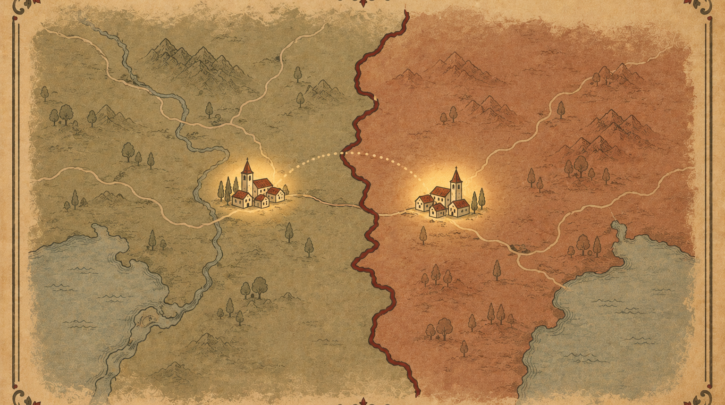

To understand where your Hungarian family is “really from” is, for a great many descendants, to look beyond the borders of today’s Hungary. Because the Treaty of Trianon redrew the map in 1920, much of the historic Kingdom of Hungary—and a great many ancestral villages—now lies in neighbouring countries, where Hungarian communities have lived ever since. This guide is an orientation to that wider Hungarian world, where so many roots lead, and what it means for your heritage and your travels.
A nation larger than its borders
The essential thing to grasp is that the Hungarian nation has long been larger than the Hungarian state. After 1920, around three million ethnic Hungarians found themselves in other countries, and their descendants form vibrant Hungarian communities to this day. For the family historian, this means “Hungarian” heritage is very often, more specifically, the heritage of one of these cross-border regions—Transylvanian, Felvidék, Vojvodina—each with its own character within the broader Hungarian culture.
Not sure where to start with your Hungarian ancestry?
Get the Hungarian Genealogy Quick-Start Checklist — a 6-step path to your first real ancestor record, plus how to work out which of six countries holds your family’s records today. No subscription required.
The main Hungarian regions beyond the border
Several regions hold large, historic Hungarian populations, and your roots may lead to any of them:
- Transylvania (Erdély), now in Romania — home to a large Hungarian population, including the Székely (Szekler) of the east, with deep traditions, historic Hungarian towns, and a strong living culture.
- Southern Slovakia (Felvidék) — the Hungarian communities of what was Upper Hungary, along the present Slovak–Hungarian border.
- The Vojvodina, now in Serbia — a multi-ethnic region with a significant Hungarian population, especially around towns like Szabadka (Subotica).
- Carpathian Ruthenia (Kárpátalja), now in Ukraine — a Hungarian community in the far west of Ukraine.
- Burgenland (now Austria) and parts of Croatia — further areas detached in 1920.
The culture that endured
What makes these communities so meaningful for heritage travel is that the Hungarian culture endured there—the language, the churches, the folk traditions, the food, the festivals, kept alive across a century under other states. Visiting Hungarian Transylvania or the Vojvodina, you encounter not a museum but a living Hungarian world: Hungarian spoken in the streets, Reformed and Catholic Hungarian churches, folk customs and village búcsú festivals, and a strong sense of identity. For a descendant, this can be profoundly moving—the discovery that the family’s world did not vanish but continues, just across a border.
Knowing your region starts with knowing your village and its country. Find both with the free records, then explore the region on your heritage trip.
The broad strokes of Hungarian culture
Wherever your roots lead, certain threads run through Hungarian heritage everywhere. The food—paprika-rich goulash and stews, stuffed cabbage, lángos, the wines of Tokaj and Eger, pálinka. The folk traditions—distinctive embroidery and folk art, csárdás dancing, rich folk music revived by the táncház (dance-house) movement. The faith—the Catholic, Reformed, Lutheran and other churches that anchored community life. And the language itself, that singular Uralic tongue, the deepest marker of Hungarian identity. These are shared across the Hungarian world, in Hungary and beyond its borders alike.
Bringing regional heritage home
You do not have to travel to reclaim your regional heritage—though it helps. Learn the history of your particular corner of the Hungarian world, and the story of how Trianon placed it where it is; cook the dishes of your region; learn about its folk traditions and its dialect; understand the church and the festivals your ancestral village kept. Each of these turns a vague sense of Hungarian-ness into a specific, rooted identity. It is part of the larger work of reclaiming your heritage—and it begins, as always, with knowing precisely where, across the historic Kingdom and its successor states, your family came from.
Finding your specific regional identity
The practical task for the family historian is to move from the generic to the specific—from “Hungarian” to the actual region your family belonged to. This is why the genealogical groundwork matters so much: only by identifying your village and its modern country do you learn which regional heritage is truly yours, with its particular history, dialect, traditions and setting. A family that always called itself simply “Hungarian” may discover it is specifically Transylvanian Székely, or from the Felvidék of southern Slovakia, or from the Vojvodina—and that discovery, far from narrowing the heritage, makes it real and rooted.
Once you know the region, a world of specific heritage opens. You can learn its history as a distinct place—including how Trianon placed it where it is—understand the forces that shaped your ancestors’ lives there, and connect with the living Hungarian community that endures in that corner of a neighbouring country. The regional lens transforms a vague ancestral fondness into the specific, living inheritance of a particular part of the historic Hungarian world.
The diaspora and the homeland communities
There is a poignant double story in Hungarian heritage that these regions illuminate. Some Hungarian families emigrated overseas, building communities in America and beyond; others never moved at all but became a minority across a border when the map changed around them. Many families experienced both—a branch that sailed to Cleveland, and cousins who stayed in a Transylvanian village that is now in Romania. Recognising your regional heritage connects these threads, linking the overseas diaspora to the homeland community in one continuous story—and it is why a heritage trip so often involves not just visiting a place but reconnecting a family scattered by both emigration and the redrawing of borders, all traceable back to a single well-documented village.