
The immigrant ancestor is the hinge of Hungarian-American genealogy. They are the person who crossed the ocean, and the records they generated in their new country are often the only place that names the village and the religion you need to continue the search in Europe. Finding that ancestor thoroughly in the destination records is therefore not a side quest—it is the bridge to everything on the Hungarian side.
Start with what you know, work backward
Begin from yourself and move back one generation at a time, gathering records for each person until you reach the immigrant. Resist the urge to jump straight to Hungary; the careful reconstruction of the immigrant generation in the destination country is what gives you the accurate names, dates, religion and birthplace to search Hungarian records successfully. A single wrong assumption here—an anglicised name taken as the original, a guessed birth year, the wrong religion—can send the whole European search astray.
Not sure where to start with your Hungarian ancestry?
Get the Hungarian Genealogy Quick-Start Checklist — a 6-step path to your first real ancestor record, plus how to work out which of six countries holds your family’s records today. No subscription required.
The key record types
Several record categories are especially valuable for identifying a Hungarian immigrant and their origin:
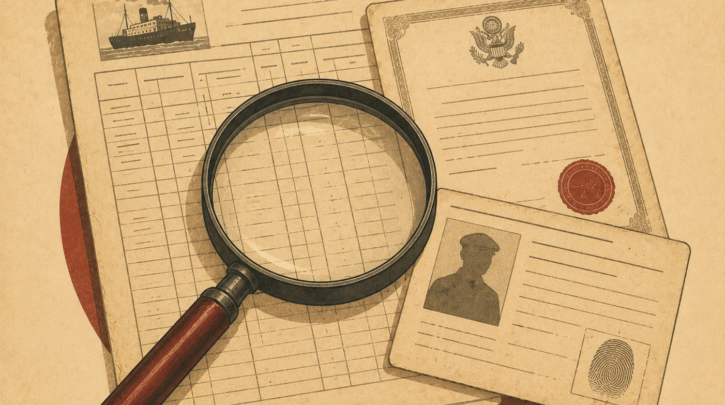
- Passenger manifests — ship records of arrival, which after about 1900 often name the town of last residence and a relative left behind; see Ellis Island and passenger records.
- Naturalisation records — declarations and petitions, which (especially after 1906) frequently state the exact birthplace and arrival details.
- Census records — placing the family in time and place, recording year of immigration, mother tongue and naturalisation status.
- Church records abroad — the immigrant congregation’s registers, which preserve the family’s religion (itself a vital clue) and sometimes the Hungarian village.
- Vital and military records — marriage and death certificates and draft cards that may name the birthplace and parents.
No single record does it all. The art is in combining them—a census mother-tongue entry distinguishing a Magyar from a Slovak or German family, a naturalisation giving a birthplace, a manifest’s relative-left-behind confirming the village.
These destination records are the bridge to Hungary. Once one names the village, the free Hungarian records open up—see the records hub and the research guide.
Watch the name and the name order
Hungarian names changed after emigration, and not at Ellis Island as the myth holds (officials worked from manifests created at the port of departure). Names were anglicised gradually—György became George, Kovács might become Kovach or Smith. Crucially, the surname-first order was flipped to Western order, and occasionally a clerk mistook the given name for the surname. To find your ancestor in the Hungarian records you need the original Hungarian form, in the original order, so treat the American version as a clue to the original rather than the original itself.
Don’t forget the religion
One thing that matters more for Hungarian research than for many others is religion. Because pre-1895 Hungarian records are kept by denomination, knowing whether your family was Roman Catholic, Greek Catholic, Reformed, Lutheran, Orthodox or Jewish is essential—and the destination records often preserve it, in the immigrant congregation they joined, the census, or family knowledge. Recovering the religion alongside the village is what lets you walk into the right church registers rather than searching blindly. With the village, the religion and the original name in hand, you are ready to cross the ocean and let the deep Hungarian record-keeping take over.
Building a timeline as you go
A practical habit makes all the difference when reconstructing an immigrant ancestor: build a timeline. As you gather each record—a census, a naturalisation, a manifest, a church entry—note the date, the place, and what it says about names, ages, birthplace and religion. Laid out chronologically, the records start to corroborate or contradict one another, and the discrepancies are often where the discoveries hide. A birth year that shifts across documents, a naturalisation that names a birthplace a census only hinted at, an arrival date that finally lets you find the manifest—the timeline turns scattered facts into a coherent case.
This approach also disciplines your conclusions. It is easy to seize on a promising record and assume it is your family; a timeline forces you to check that each new document is consistent with everything else you know. For Hungarian research, where common surnames and anglicised names create real risk of confusing two families, this rigour is essential—and it is exactly what gives you the reliable name, religion and birthplace you need before crossing into the Hungarian records.
When records disagree or go missing
Immigrant records frequently disagree—on ages, on the spelling of names, even on birthplaces—and some you hope for will simply not exist or survive. The response is not to despair but to widen the net: pursue every member of the immigrant generation, not just your direct ancestor, because a sibling’s clearer naturalisation or a cousin’s manifest may name the village your own ancestor’s records leave vague. Chain migration means relatives and fellow villagers travelled and settled together, so the community around your ancestor is itself a source. Patience and breadth, more than any single document, are what carry you reliably from an American street back to a Hungarian village.