
Your Hungarian surname is a small inheritance from the past, and decoded it often reveals something about an ancestor: what they looked like, what they did, where they came from, or even which of the many peoples of the old Kingdom of Hungary they belonged to. Hungarian surnames are unusually rich in meaning, and understanding yours is both a pleasure and, sometimes, a research clue. This guide explains where Hungarian surnames come from, the main types they fall into, and how to begin researching your own.
Two features set Hungarian names apart and are worth fixing in mind from the start: the surname comes first (the order is reversed from Western practice), and many surnames record ethnic origin within the multi-ethnic Kingdom—a feature you will meet nowhere quite so vividly as in Hungary. We will come to both.
When Hungarians acquired surnames
Hereditary surnames appeared among the Hungarian nobility in the medieval period and spread gradually to the wider population over the following centuries, becoming general and stable by the time church registers were well established and certainly by the start of civil registration in 1895. For Jewish families, surnames were largely adopted later, following an imperial decree of 1787 that required them. By the nineteenth century, surnames were fixed and inherited across most of society—though, as we will see, many were deliberately changed during the era of Hungarian nationalism.
Not sure where to start with your Hungarian ancestry?
Get the Hungarian Genealogy Quick-Start Checklist — a 6-step path to your first real ancestor record, plus how to work out which of six countries holds your family’s records today. No subscription required.
The surname-first order
The most distinctive feature of Hungarian names is the order: family name first, given name second. Nagy János is a man whose surname is Nagy and given name János (John). This Eastern name order, unique in Europe to Hungarian, is standard throughout the records—and it was usually flipped when families emigrated, which is a frequent source of confusion in tracing names across the ocean.
The four main types of Hungarian surname
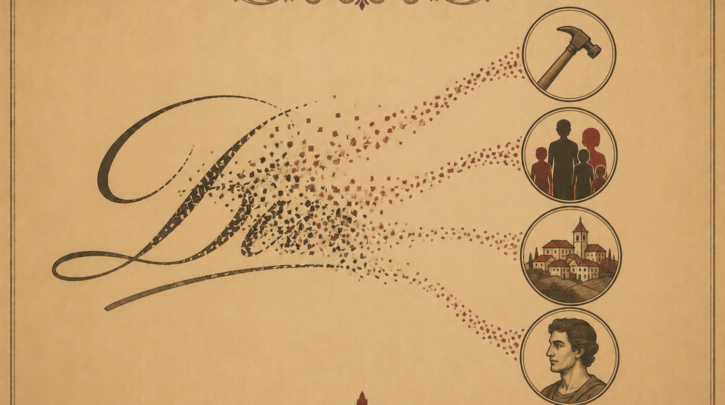
Most Hungarian surnames fall into four broad categories, each reflecting a different way families came to be named:
- Descriptive (nickname) — from a trait, such as Nagy (big/great), Kis(s) (small), Fekete (black), Fehér (white) or Balog(h) (left-handed).
- Occupational — from a trade, such as Kovács (smith), Szabó (tailor), Molnár (miller), Varga (cobbler) or Mészáros (butcher).
- Ethnic or geographic origin — recording where, or which people, an ancestor came from: Tóth (a Slav, usually Slovak), Horváth (Croatian), Németh (German), Oláh (Romanian), or place-names like Erdélyi (from Transylvania).
- Patronymic — from an ancestor’s given name, such as Pál, Péter, Balázs, sometimes with the suffix -fi or -ffy meaning “son of.”
We explore these in depth, with many examples, in our guide to Hungarian surname meanings.
Curious what your name says about your origins—and where it might point in Hungary? Decode it in surname meanings, then learn to trace it in researching your Hungarian surname.
The Magyarization story
One feature of Hungarian surnames deserves special mention because it trips up so many researchers: in the nineteenth and early twentieth centuries, amid rising Hungarian nationalism, large numbers of families Magyarized their names—changing a German, Slovak, or other surname to a Hungarian one. An ancestor might appear under a German name in earlier records and a Hungarian one later. This, along with the adoption of surnames by Jewish families, is explored in our guide to Magyarized and adopted Hungarian surnames.
Why your surname matters for research
Beyond its meaning, a surname is a research tool. Its type can hint at your family’s background—an ethnic-origin name suggests a particular community and likely religion; a Magyarized name flags a possible earlier form to search; a distinctive or regional name can even help point toward an area. Whether your name is the smith’s Kovács, the “big” Nagy, or the Slovak-origin Tóth, it is a thread worth pulling—and one that, with the records, can lead back toward the village your family came from.
Start pulling the thread: see the most common Hungarian surnames, decode yours in surname meanings, and trace it back with the research guide.
A multi-ethnic kingdom written in names
One of the first things that strikes anyone exploring Hungarian surnames is how much history they carry, and in particular how vividly they record the diversity of the old Kingdom of Hungary. Where some countries’ surnames are overwhelmingly drawn from the majority language, Hungary’s common names include a striking number that name other peoples—Tóth the Slovak, Horváth the Croatian, Németh the German, Oláh the Romanian, Rácz the Serbian. These were a multi-ethnic society’s way of marking who came from where, and they remain among the most frequent surnames in Hungary today, a permanent reminder that the Kingdom was home to many peoples living side by side.
This diversity is a gift to the genealogist, because an ethnic-origin surname is genuinely informative: it suggests the community an ancestor belonged to or descended from, which in turn hints at their likely religion and the kinds of records to search. Learning to read these signals—the meaning, the type, the possibility of a later change—turns your family name from a mere label into a piece of evidence about your family’s place in that rich world.
Surnames and the search for your village
Throughout this site we return to one central fact of Hungarian genealogy: you must know the village (and the religion) to find your family in the records. Your surname is one of the tools that can help. A geographic name may point toward a region; an ethnic-origin name may suggest which community and area; and a distinctive or locally concentrated name can, with the right tools, help narrow the search. The surname rarely names the village outright, but combined with the immigrant records and a little knowledge of its meaning and history, it is a genuine aid in the hunt.
So treat your surname as more than heritage trivia. Decode its meaning, consider whether it was Magyarized or adopted, learn its variants and its anglicised drift, and you arm yourself with clues that, alongside the records, help lead you back to the place and people your family came from.