
For the descendants of Hungarian emigrants—and of the millions of ethnic Hungarians left beyond the borders by the Treaty of Trianon—Hungarian citizenship offers a path to Hungary and, with it, the European Union. Since 2011, it has been achievable from abroad, without living in Hungary. But it comes with one serious condition that no honest guide can gloss over: for most applicants, you must speak Hungarian. This guide explains the two routes, who qualifies, and what the process really involves.
Important: This article is general information for educational purposes, not legal advice. Hungarian citizenship rules are detailed and can change, and the outcome of any application depends on the specific facts of your family history. Always verify the current rules with official Hungarian government sources (your Hungarian consulate or the relevant Hungarian authority) and consider consulting a qualified professional before acting on any of this.
Two routes: which one is yours?
Hungarian citizenship passes by descent (jus sanguinis), and which procedure applies depends on how recent your Hungarian-citizen ancestor is. This distinction is the most important thing to understand, because the two routes differ above all in the language requirement:
- Verification of citizenship — if at least one of your parents was a Hungarian citizen at the time of your birth, you may already be a Hungarian citizen without knowing it. You file to verify and confirm your existing status. Crucially, verification does not require Hungarian language ability.
- Simplified naturalization (egyszerűsített honosítás) — if your Hungarian ancestor is further back (a grandparent, great-grandparent, or beyond), you apply through this process. It requires proving descent and demonstrating Hungarian language ability.
We compare the two in detail in verification versus naturalization—and which applies to you is the first thing to establish.
Not sure where to start with your Hungarian ancestry?
Get the Hungarian Genealogy Quick-Start Checklist — a 6-step path to your first real ancestor record, plus how to work out which of six countries holds your family’s records today. No subscription required.
Who qualifies
Simplified naturalization is open, broadly, to those who can prove descent from a person who was a Hungarian citizen—including a citizen of the pre-1920 Kingdom of Hungary, which is why so many ethnic Hungarians from the Trianon territories qualify. Key features set it apart from most citizenship-by-descent programs:
- No generational limit — you can trace back through any number of generations, provided you document the chain.
- No residency requirement — you apply from abroad, through a consulate, without living in Hungary.
- Dual citizenship allowed — Hungary does not require you to renounce your existing citizenship (check your own country’s rules).
- Citizenship, not ethnicity — you must prove a documented citizen ancestor and an unbroken chain to you, not merely Hungarian heritage.
The detail—including some historical complications—is covered in who qualifies for Hungarian citizenship by descent.
The language requirement
For the simplified-naturalization route, this is the condition that decides most cases: you must be able to communicate in Hungarian at a conversational to intermediate level, and the entire process—including the interview—is conducted in Hungarian. There is no adult exemption, and Hungarian authorities verify it directly. Because Hungarian is a difficult language for most learners, this is usually the single biggest task of the whole undertaking, and we treat it honestly in our guide to the Hungarian language requirement.
Be wary of any service promising Hungarian citizenship by descent without genuine Hungarian language ability for the simplified-naturalization route. Hungary’s consulates state plainly that the requirement is verified and not waived for adults. The honest path starts with learning the language—or with checking whether the no-language verification route applies to you.
The documents
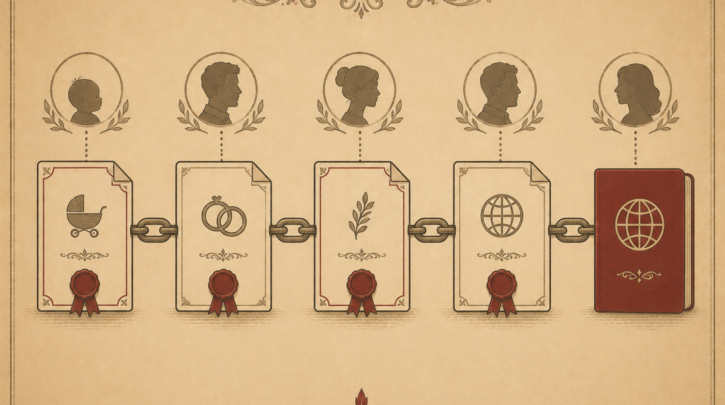
Every claim rests on a documented chain proving your descent from the Hungarian-citizen ancestor: birth and marriage records for each generation, evidence of the ancestor’s Hungarian citizenship, a criminal-record certificate, and a handwritten CV—all foreign documents apostilled and accompanied by certified Hungarian translations. Assembling this chain is the genealogical heart of the task, detailed in documents for Hungarian citizenship, and it is exactly what this site helps you build.
Begin by confirming your most recent Hungarian ancestor and finding the records—start with tracing your Hungarian ancestry and the records hub. For document procurement, certified translation and language help, see the citizenship guide.
The process and timeline
Applications are submitted in person, by appointment, at a Hungarian consulate (or in Hungary), often after pre-filling the forms through Hungary’s online system. After submission a decision typically takes around a year, and citizenship is acquired on the day you take the oath. The full sequence is covered in our guide to the Hungarian citizenship application process.
Is it worth it?
Hungarian citizenship is also EU citizenship, with the right to live, work and study across the Union—alongside the deep meaning of reconnecting with an ancestral homeland. That combination is why hundreds of thousands have pursued it. The honest counterweight is the language requirement for the simplified route, which is a genuine commitment of time and effort. Knowing which route applies to you, and being clear-eyed about the language, is the foundation of a realistic plan—and the genealogical groundwork this site helps with serves you whichever route you take.
Start with the groundwork that every route needs: trace and document your Hungarian-citizen ancestor with the research guide and free records, then explore document, translation and language help on the citizenship hub.
The Trianon context that makes this possible
Hungary’s citizenship-by-descent program is unusually generous, and the reason is historical. When the Treaty of Trianon redrew the borders in 1920, around three million ethnic Hungarians found themselves living in other countries. The 2010–2011 reform that created modern simplified naturalization was designed explicitly to reconnect with these “Hungarians beyond the borders” and their descendants—which is why eligibility reaches back to citizens of the pre-1920 Kingdom and why there is no generational limit or residency requirement. For descendants of the diaspora, this history is the foundation of their eligibility today.
It also explains the language requirement. Because the program is meant to reflect a genuine, living connection to Hungarian identity—not merely distant ancestry—the simplified-naturalization route asks applicants to demonstrate that connection through the language. Understanding the policy’s purpose makes its requirements easier to grasp: Hungary is reconnecting with people it regards as part of the nation, and the ability to speak Hungarian is, in that framing, the mark of belonging.
How this site helps
Hungarian Roots cannot give legal advice or process your application—those are tasks for qualified professionals and the Hungarian authorities. What it can do is help with the part every claim depends on regardless of route: the genealogy. Identifying your most recent Hungarian-citizen ancestor, finding their records (including the church registers for a pre-1895 ancestor), locating the village across today’s borders, and documenting the unbroken chain are the foundation of any claim—and exactly what our research guides support.
From that foundation, the specialised questions—which route applies, the language, the documents, the historical complications—are ones to take to a qualified professional, with resources on our citizenship hub. Genealogy first, legal assessment second: that order serves almost everyone well, because without the documented ancestor and chain, no route is open at all.