
You took a DNA test expecting to see “Hungarian,” and instead your results are a spread of Eastern European, Balkan, Central European—perhaps a little of half a dozen neighbouring labels—with no tidy “Magyar” slice at all. This is normal, and it reflects one of the most fascinating facts about Hungarian ancestry: the Hungarian language came from the east, but the Hungarian gene pool is overwhelmingly Central European. Understanding why helps you read your results sensibly and avoid the common misconceptions.
The Magyar puzzle: language from the east, genes from here
The Magyars—the Hungarian people—arrived in the Carpathian Basin around the end of the ninth century, having migrated from the east. Their language is Uralic, related to Finnish and to languages of the Ural region, utterly unlike the Indo-European languages all around it. You might therefore expect a distinctive eastern genetic signal. But over more than a thousand years of living among, and marrying with, the surrounding Central European peoples, the genetic contribution of the original eastern arrivals was diluted to a small trace in the general population. The result is that modern Hungarians are, genetically, broadly Central European—similar to their Slavic, Austrian and other neighbours—even as they kept a language from far away.
Not sure where to start with your Hungarian ancestry?
Get the Hungarian Genealogy Quick-Start Checklist — a 6-step path to your first real ancestor record, plus how to work out which of six countries holds your family’s records today. No subscription required.
Why ‘Hungarian’ isn’t a clean category
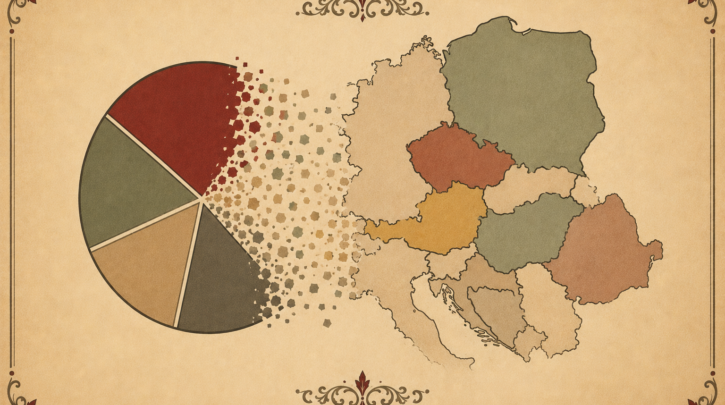
This history is exactly why the testing companies struggle to show a distinct “Hungarian” ethnicity. Because the Hungarian gene pool overlaps heavily with those of neighbouring populations, your results are likely to appear as a blend of broad regional categories—Eastern European, Central European, Balkan, and the like—rather than a single “Hungarian” figure. The exact labels and percentages also shift with every update to the companies’ methods. None of this means your test is wrong or that you are “not really Hungarian”; it means Hungarian ancestry simply does not have a tidy, isolated genetic signature.
The multi-ethnic mix
There is a second reason Hungarian results are varied: the old Kingdom of Hungary was deeply multi-ethnic. A family that considered itself Hungarian may carry the DNA of the Kingdom’s many peoples—Slovak, German, Romanian, Serbian, Croatian, Rusyn—reflected in surnames like Tóth, Németh or Horváth. Seeing such elements in your results is normal and historically accurate, not a surprise to be explained away. It is the genetic echo of a society in which many peoples lived side by side for centuries.
Your matches—not your ethnicity pie chart—are where the genealogy lives. Learn to use them in finding Hungarian relatives with DNA, and choose a test on the DNA hub.
A note on Hungarian Jewish ancestry
One important exception to the “no clean signal” rule concerns Hungarian Jewish ancestry. Hungary had a large Jewish population, and Ashkenazi Jewish ancestry does show up clearly and distinctly in DNA results—and, because Ashkenazi communities were historically endogamous (marrying within the community over many generations), it also produces large numbers of matches and can make relationships appear closer than they are. If you have Hungarian Jewish roots, expect a clear Ashkenazi component and many matches, and lean especially hard on documents rather than shared-centimorgan totals when working out exact relationships.
What ethnicity estimates cannot do
The single most important thing to remember is that an ethnicity estimate cannot name your village, your county, or even reliably your specific region. For Hungarian ancestry, where the signal is a broad Central European blend, this is especially true: the percentages confirm a general origin you likely already suspected, but they cannot point to the village, and only the records and your matches can do that. Enjoy the deep-history story your DNA tells—the language from the east, the genes from the heart of Europe—but build your genealogy on the documents.
Reading your regional breakdown sensibly
When your results spread “Hungarian” ancestry across several regional labels, hold the breakdown loosely. The companies estimate these by comparing your DNA to reference panels, and because Hungarian and the surrounding Central European populations overlap so heavily, the regional percentages are genuinely fuzzy and shift with every update to the methodology. A thoroughly Hungarian family might see their ancestry distributed across Eastern European, Balkan and Central European labels in proportions that change overnight without a single new fact entering their tree. That alone tells you how much genealogical weight to place on the regional split: very little.
Used wisely, though, the breakdown can still be interesting. It situates your family in the deep history of the region, and the appearance of neighbouring-population elements is an accurate reflection of the multi-ethnic Kingdom of Hungary your ancestors came from. Enjoy the story the estimate tells about where, broadly, your deep ancestry lies—while keeping the genealogy itself firmly grounded in documents, which are the only thing that can identify a region, a county, or a village.
The deep-history fascination
Hungarian DNA results reward a little curiosity about deep history, because they sit at a genuinely interesting crossroads. The story of a people who carried a Uralic language thousands of miles west and kept it for over a millennium, while their genes gradually became those of their Central European neighbours, is one of Europe’s most striking examples of language and ancestry diverging. Some Hungarians do carry small traces associated with the early eastern arrivals, and ongoing research into the genetics of the Magyar conquest period continues to refine the picture. For the family historian, this is rich background rather than practical genealogy—but it adds a layer of meaning to a test result that might otherwise look disappointingly like “generic Eastern European,” and it is a reminder that your ancestry is part of a long and remarkable history.